Free printable worksheet · Economics
Free national debt chart worksheet with answer key
How big is the federal debt compared with the economy? A one-page worksheet on a chart of trustworthy public data, with three questions and lines to write on, plus an answer key for you. Free, no account needed, and the numbers are the newest the source has published.
The chart on the worksheet
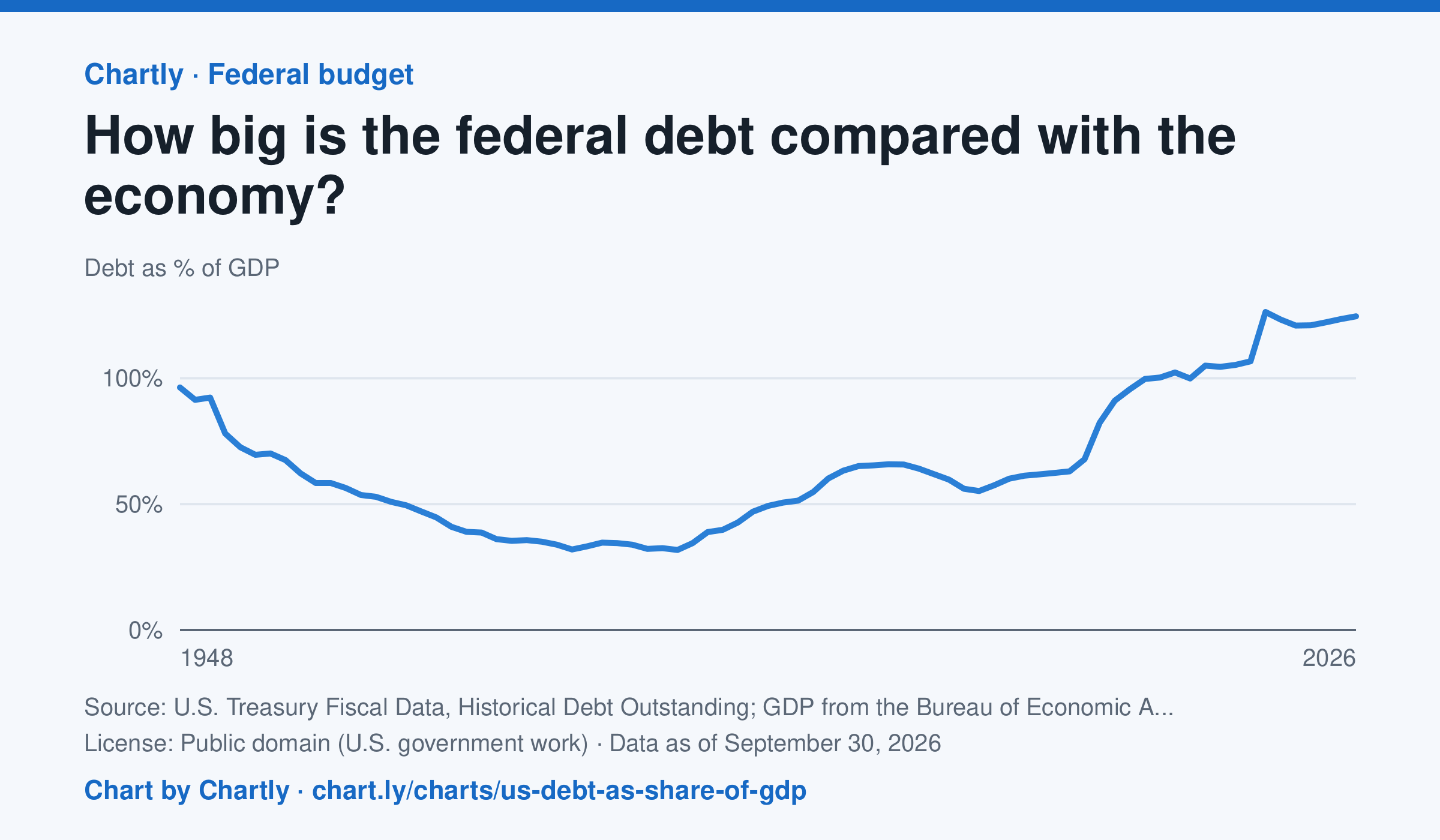
At the end of fiscal 2026 the federal debt was 125% of a year's GDP, everything the U.S. economy produces in a year. It fell from 96% in 1948 to a low of 32% in 1981, passed 100% in 2013 and jumped to 126% in 2020. This is total debt, including what the government owes its own trust funds, divided by GDP over the same fiscal year; it starts in 1948 because BEA's quarterly GDP starts in 1947, and recent GDP figures are revised.
Source: U.S. Treasury Fiscal Data, Historical Debt Outstanding; GDP from the Bureau of Economic Analysis (NIPA Table 1.1.5) (Public domain (U.S. government work)) · Data as of Sep 30, 2026 · Open the interactive chart and its numbers
What students answer
How to read this chart
Each point divides the federal government's total debt by GDP, everything the U.S. economy produces in a year. At 100%, the debt equals one year of the whole economy's output. Comparing debt with the economy's size, instead of in dollars, makes years decades apart fair to compare.
Questions to discuss
- When was the debt smallest compared with the economy, and when was it largest?
- The debt can grow in dollars while this percentage falls. How is that possible?
- Pick a big jump on the chart. What events could make the government borrow much more in a short time?
The answer key gives the chart's key numbers (newest, highest, lowest, biggest change) and, for each question, the figures it asks about, written from the same data students see.
Or assign it online
Post this link in Google Classroom, Canvas or Moodle. Students see the interactive chart and the questions; they don't need an account.
A chart for class, every Monday
One fresh chart of public data, three questions to discuss and a link that opens it as a class assignment, in your inbox each Monday. Free, no account. See this week's.