Free printable worksheet · Health
Free causes of death chart worksheet with answer key
What do Americans die of most often? A one-page worksheet on a chart of trustworthy public data, with three questions and lines to write on, plus an answer key for you. Free, no account needed, and the numbers are the newest the source has published.
The chart on the worksheet
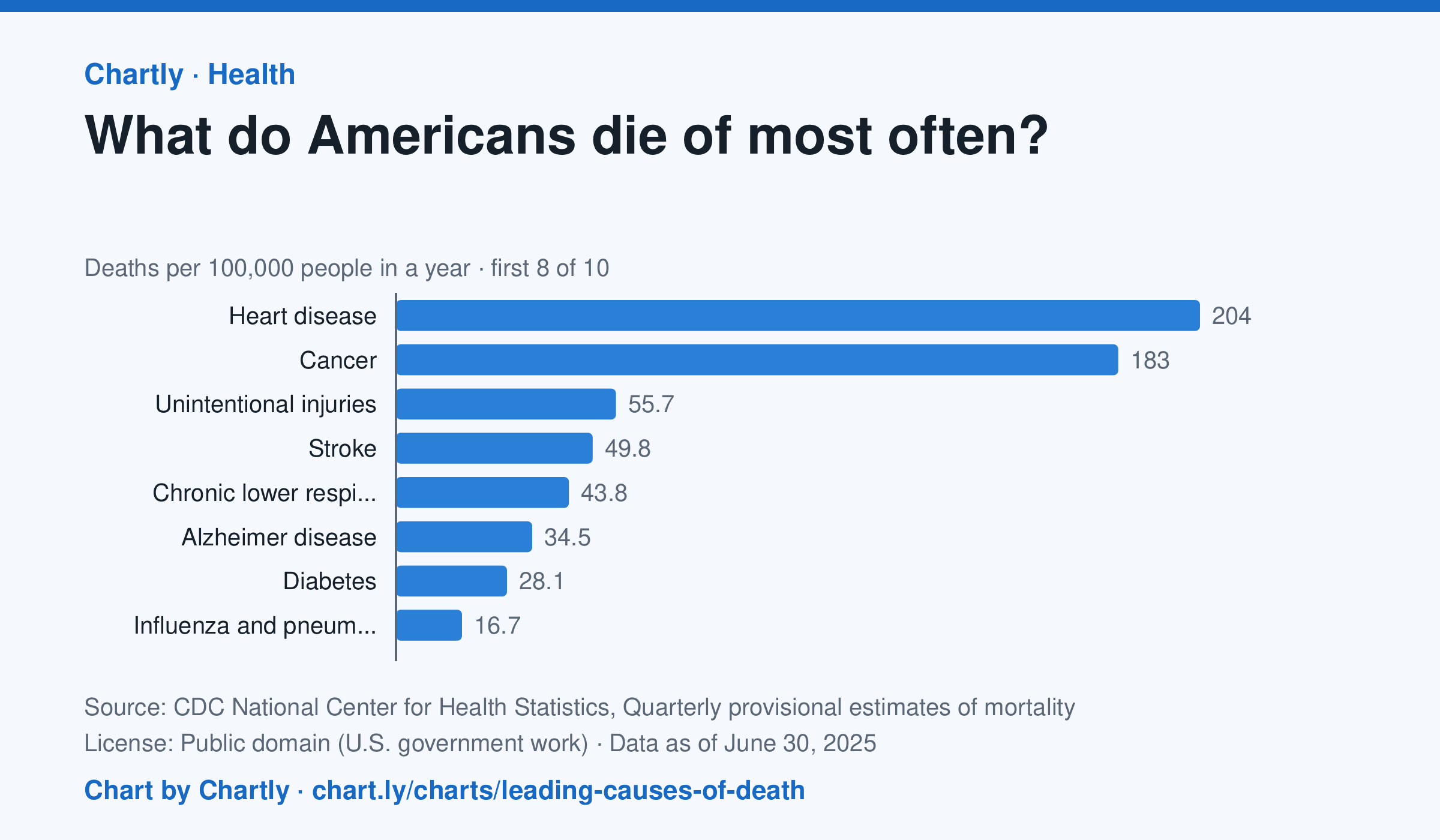
In the 12 months through June 2025, heart disease (204 deaths per 100,000 people) and cancer (183) were the leading causes of death in the US, and unintentional injuries came third at 56. Unintentional injuries include accidental overdoses, falls and traffic crashes. The numbers are provisional and may change a little as records are completed.
Source: CDC National Center for Health Statistics, Quarterly provisional estimates of mortality (Public domain (U.S. government work)) · Data as of Jun 30, 2025 · Open the interactive chart and its numbers
What students answer
How to read this chart
Each bar is how many people out of every 100,000 died of one cause in a year. A rate, instead of a count, lets you compare causes fairly even as the population grows. The bars start at zero, so a bar twice as long means twice as many deaths.
Questions to discuss
- Which two causes are far ahead of the rest? How many times bigger is the top cause than the smallest bar?
- Which of these causes could people lower with exercise, diet or not smoking?
- Why might the leading causes of death be very different for teenagers than for everyone together?
The answer key gives the chart's key numbers (newest, highest, lowest, biggest change) and, for each question, the figures it asks about, written from the same data students see.
Or assign it online
Post this link in Google Classroom, Canvas or Moodle. Students see the interactive chart and the questions; they don't need an account.
A chart for class, every Monday
One fresh chart of public data, three questions to discuss and a link that opens it as a class assignment, in your inbox each Monday. Free, no account. See this week's.