Free printable worksheet · Math
Free household income by state chart worksheet with answer key
What is the typical household income in each state? A one-page worksheet on a chart of trustworthy public data, with three questions and lines to write on, plus an answer key for you. Free, no account needed, and the numbers are the newest the source has published.
The chart on the worksheet
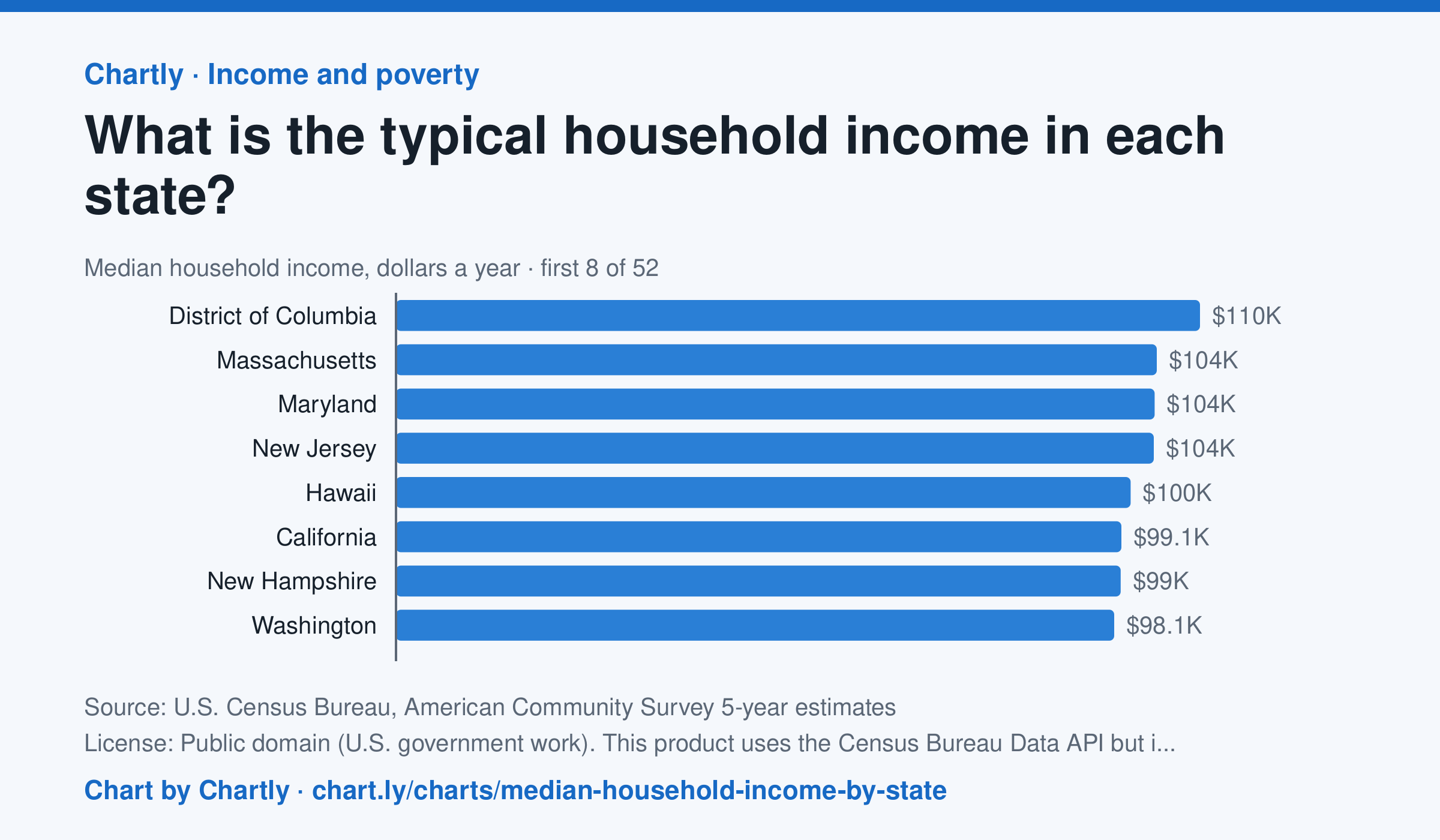
In the Census Bureau's 5-year survey ending in 2024, the typical household in District of Columbia earned $109,870 a year, the most, followed by Massachusetts ($103,960) and Maryland ($103,678). Mississippi was lowest at $56,447, and the U.S. median was $80,734. These are 5-year estimates in 2024 dollars, each with a margin of error.
Source: U.S. Census Bureau, American Community Survey 5-year estimates (Public domain (U.S. government work). This product uses the Census Bureau Data API but is not endorsed or certified by the Census Bureau.) · Data as of Dec 31, 2024 · Open the interactive chart and its numbers
What students answer
How to read this chart
Each bar is the median household income in a state: half of households earn more and half earn less. The dashed line is the whole U.S., for comparison. These are survey estimates, and each has a margin of error: the true value is likely within that range, so states with overlapping ranges may not really differ.
Questions to discuss
- Find your state. Is it above or below the U.S. median, and by about how much?
- Why do statisticians often use the median instead of the average (mean) for income?
- Housing and groceries cost more in some states. What would you need to know to compare what these incomes can buy?
The answer key gives the chart's key numbers (newest, highest, lowest, biggest change) and, for each question, the figures it asks about, written from the same data students see.
Or assign it online
Post this link in Google Classroom, Canvas or Moodle. Students see the interactive chart and the questions; they don't need an account.
A chart for class, every Monday
One fresh chart of public data, three questions to discuss and a link that opens it as a class assignment, in your inbox each Monday. Free, no account. See this week's.