Which telescopes have found the most exoplanets?
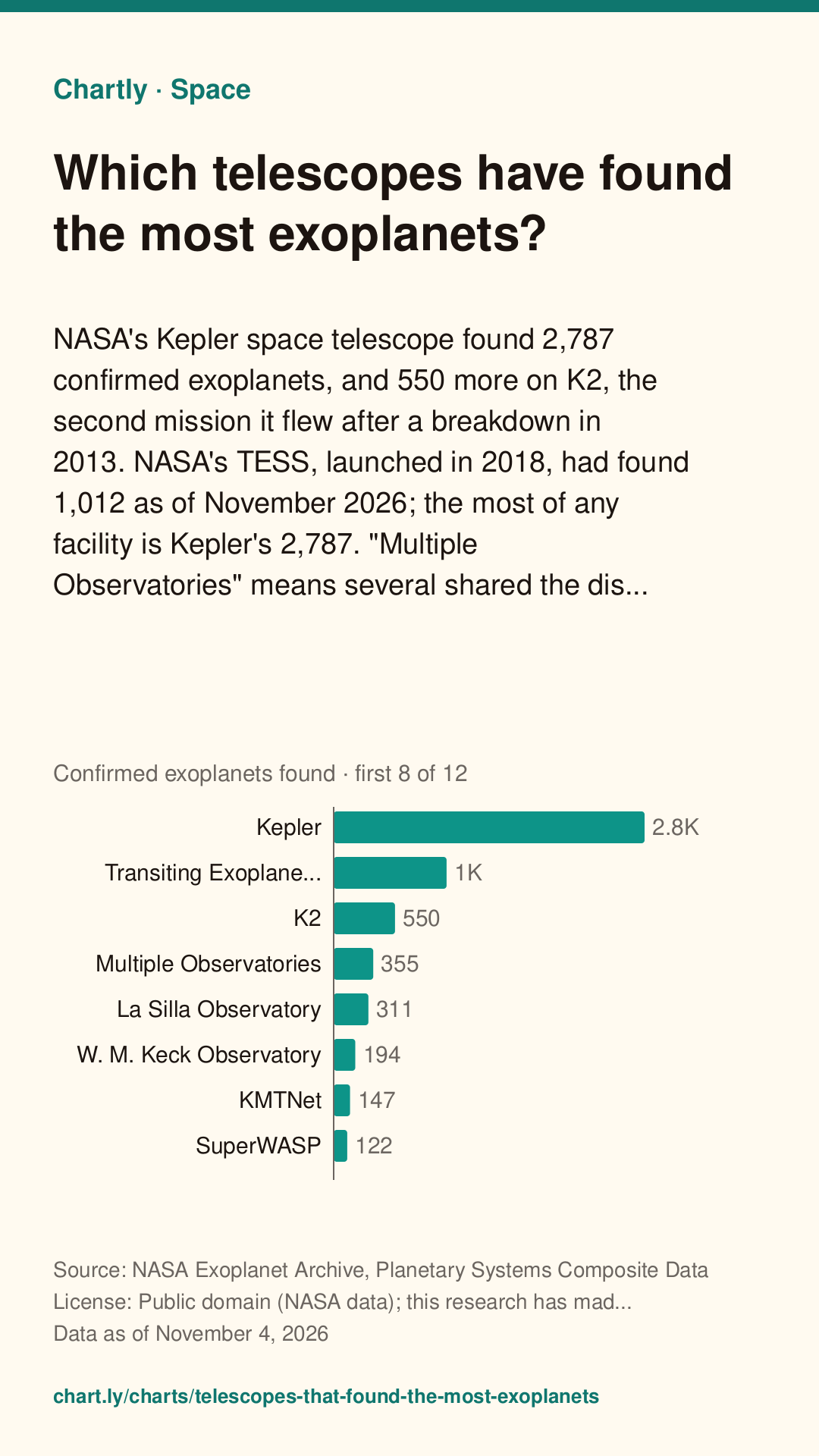
NASA's Kepler space telescope found 2,787 confirmed exoplanets, and 550 more on K2, the second mission it flew after a breakdown in 2013. NASA's TESS, launched in 2018, had found 1,012 as of November 2026; the most of any facility is Kepler's 2,787. "Multiple Observatories" means several shared the discovery.
The interactive chart needs JavaScript. The numbers are in the table below.
The value axis starts at zero. Hover, tap or use the arrow keys to read exact values.
Save a simple drawing of this chart for slides, essays or posts, with its question, source, date and a link back to this page. Please keep the credit.
Download image
A tall picture for Pinterest or an Instagram story, with the question, answer, source, date and this page's address.
Chartly Pro: downloads and embeds without the credit. Join the waitlist
It doesn't exist yet. Tell us what you'd use it for, and we'll email you once when it's ready. Downloads and embeds with the credit stay free.
Key facts
Measure: Confirmed exoplanets found. Written from the data below.
- Kepler has the highest figure, 2,787, followed by Transiting Exoplanet Survey Satellite (TESS) (1,012) and K2 (550).
- HATNet has the lowest figure, 67, followed by Haute-Provence Observatory (69) and HATSouth (73).
- The highest is 42 times the lowest.
Teachers: add this chart to a class assignment, one link to post in Google Classroom, Canvas or Moodle.
Source and date
- Data as of
- Published
Citation
Chartly. “Which telescopes have found the most exoplanets?” Chart. Data: NASA Exoplanet Archive, Planetary Systems Composite Data, https://exoplanetarchive.ipac.caltech.edu/cgi-bin/TblView/nph-tblView?app=ExoTbls&config=PSCompPars (data as of November 4, 2026). https://chart.ly/charts/telescopes-that-found-the-most-exoplanets (accessed November 4, 2026).
Free for your article, blog or class page: paste this code where the chart should go. It shows the interactive chart with its source and a small “Chart by Chartly” credit, and stays up to date when the data changes. Need it without the credit? Join the Chartly Pro waitlist.
The data
Download data (CSV)The file has the numbers in this table, with the source, license and date. Please credit the source and Chartly. Developers can also get them as JSON (how).
| Telescope or observatory | Confirmed exoplanets found |
|---|---|
| Kepler | 2,787 |
| Transiting Exoplanet Survey Satellite (TESS) | 1,012 |
| K2 | 550 |
| Multiple Observatories | 355 |
| La Silla Observatory | 311 |
| W. M. Keck Observatory | 194 |
| KMTNet | 147 |
| SuperWASP | 122 |
| OGLE | 112 |
| HATSouth | 73 |
| Haute-Provence Observatory | 69 |
| HATNet | 67 |
Get new charts weekly
One email a week with the newest charts and their key numbers. No account needed.
More Space charts
-
How many near-Earth asteroids are discovered each year?
Sky surveys found 3,240 new near-Earth asteroids in 2025, about 8.9 times the 363 found in 2000. Most new finds are small: the big ones, a kilometer or more ...
Source: NASA/JPL Center for Near Earth Object Studies (CNEOS), Discovery Statistics · Data as of Dec 31, 2025
-
How do astronomers find planets around other stars?
As of November 2026, 4,785 of the 6,451 confirmed exoplanets, about 74%, were found by the transit method: a telescope sees a star dim slightly as a planet p...
Source: NASA Exoplanet Archive, Planetary Systems Composite Data · Data as of Nov 4, 2026
-
How many planets outside our solar system are discovered each year?
Astronomers confirmed 246 new planets around other stars in 2025. The first were found in 1992, and the count leaped in 2014 and 2016 (872 and 1,504), when N...
Source: NASA Exoplanet Archive, Planetary Systems Composite Data · Data as of Dec 31, 2025
-
What are the closest asteroid flybys ever recorded?
As of November 2026, the closest known asteroid flyby was 2025 UC11 (Oct 30, 2025), about 228 km above Earth's surface; the International Space Station orbit...
Source: NASA/JPL Center for Near Earth Object Studies (CNEOS), SBDB Close Approach Data · Data as of Nov 4, 2026