Print this worksheet, or choose "Save as PDF" in the print window to share a file.
Chart worksheet
Health careers chart assignment
Name:
Class:
Date:
Chart 1 of 2 · Earthquakes
How much rarer is each step up in earthquake magnitude?
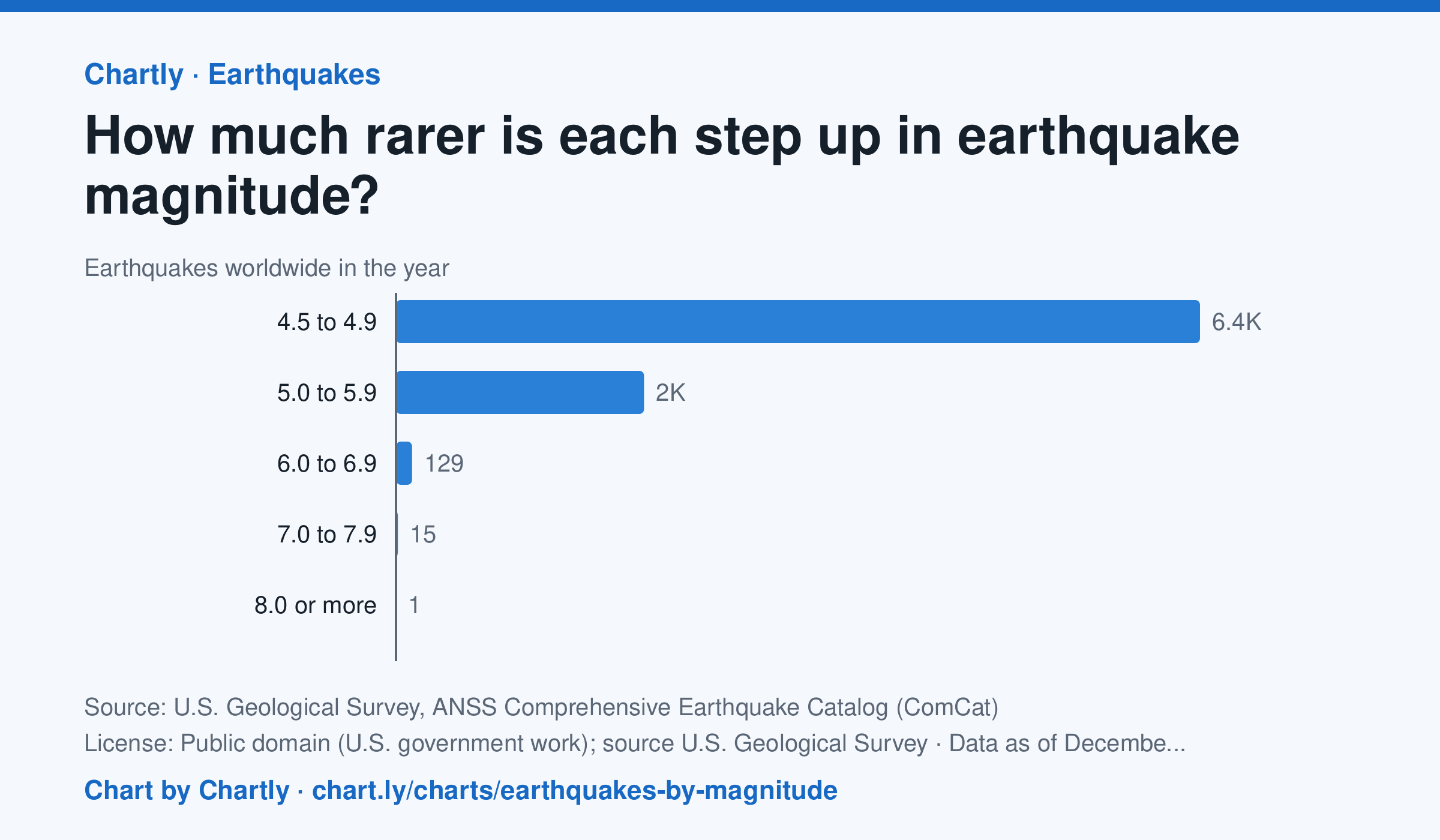
In 2025 the world recorded 6,428 earthquakes of magnitude 4.5 to 4.9, 1,983 of magnitude 5, 129 of magnitude 6, 15 of magnitude 7 and 1 of magnitude 8 or more. Each step up in magnitude is roughly ten times rarer, and releases about 32 times more energy. Countless smaller quakes go unrecorded worldwide, so the chart starts at 4.5.
Source: U.S. Geological Survey, ANSS Comprehensive Earthquake Catalog (ComCat) (Public domain (U.S. government work); source U.S. Geological Survey) · Data as of Dec 31, 2025
How to read this chart
Each bar counts the earthquakes recorded worldwide in one year within a range of magnitudes. The bars start at zero. Each whole step up in magnitude releases about 32 times more energy, so a magnitude 7 quake is far more than one step stronger than a 6.
Questions
- Roughly how many times more common is each band than the one above it?
- The biggest bars are hard to compare with the smallest ones on this scale. What other way could you show these numbers?
- The chart starts at magnitude 4.5. Why might smaller earthquakes around the world go uncounted?
Chart and numbers: chart.ly/charts/earthquakes-by-magnitude · More free charts at chart.ly
Chart 2 of 2 · World
How has the world's population grown since 1960?
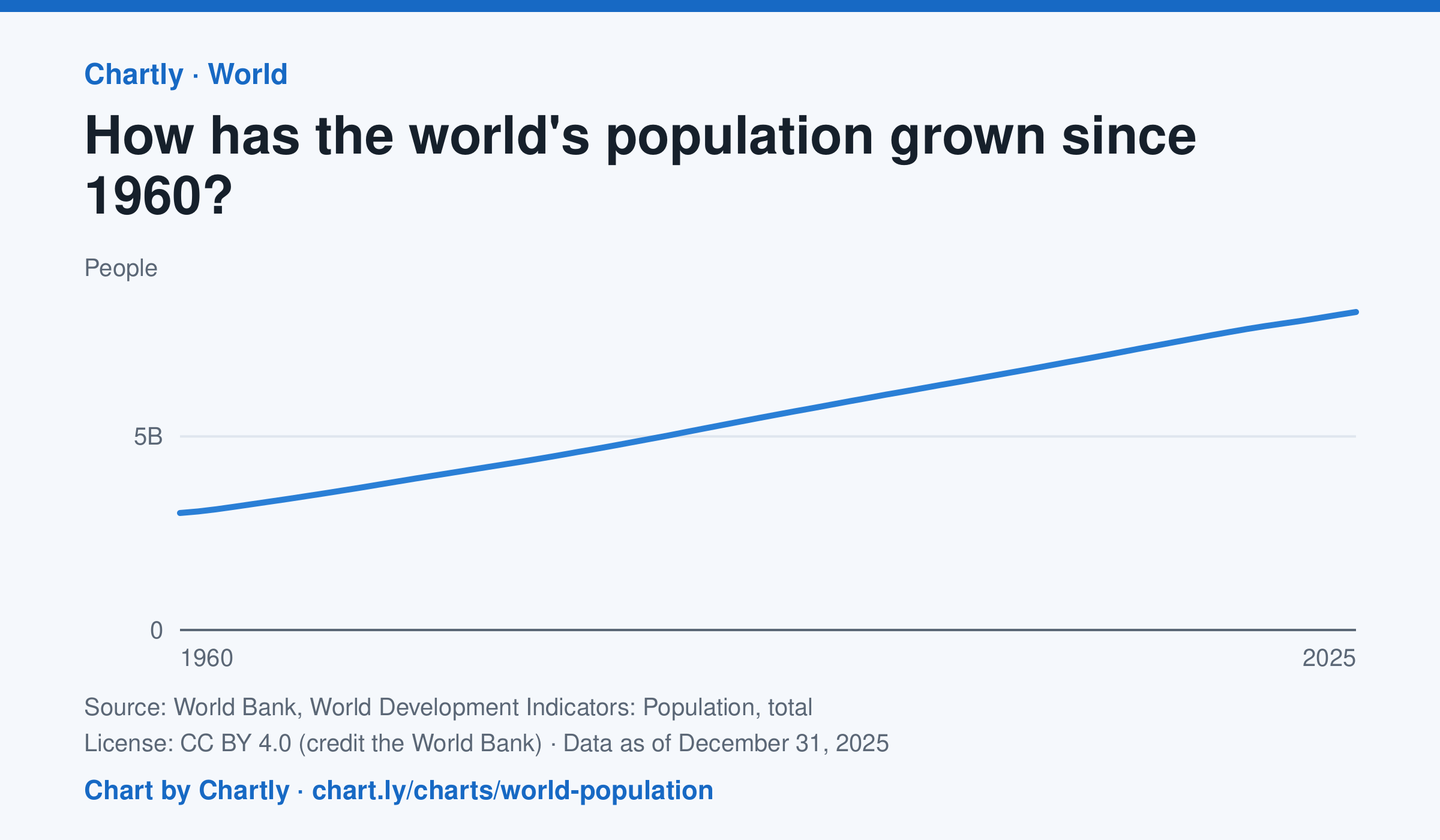
The world had 8.22 billion people in 2025, about 2.7 times the 3.02 billion of 1960. It passed 8 billion in 2023. Figures are mid-year estimates from the United Nations, which revises them as new censuses come in.
Source: World Bank, World Development Indicators: Population, total (CC BY 4.0 (credit the World Bank)) · Data as of Dec 31, 2025
How to read this chart
Each point is the number of people alive in the world in the middle of that year, estimated by the United Nations. The axis starts at zero, so the height of the line shows the true size. Look at how steep the line is to see how fast the population grew.
Questions
- Judging from the chart, about how many years did it take the world to add its most recent billion people?
- Is the line getting steeper or flatter in recent years? What does that tell you about the growth rate?
- These numbers are estimates that the UN revises. Why is it hard to count every person on Earth?
Chart and numbers: chart.ly/charts/world-population · More free charts at chart.ly